
 |
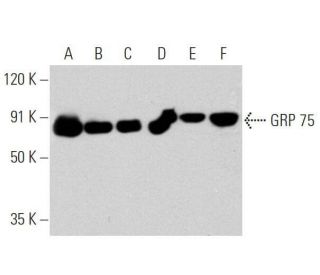
GRP 75 (H-155) Antibody: sc-13967 |
| Datasheet |
|
- rabbit polyclonal IgG, 200 µg/ml
- raised against amino acids 525-679 of the 75 kDa GRP 75 of human origin
- recommended for detection of GRP 75 of mouse, rat and human origin by WB, IP, IF, IHC(P) and ELISA; also reactive with additional species, including equine, canine, bovine, porcine and avian
|
|
| |
Ordering InformationProduct Citations
Recommended Support Products:
(click button of application of choice)
| |
| Species |
Gene Name |
Gene ID |
Chromosome Location |
Isoform (mRNA) Accession # |
Protein Accession # |
OMIM™ Number |
| Human |
HSPA9 |
3313 |
5q31.2 |
NM_004134 |
P38646
|
600548 |
| Mouse |
Hspa9 |
15526 |
18 B1 |
|
P38647
|
N/A |
| |
GRP 75 Background Information The HSP 70 family is composed of four highly conserved proteins: HSP 70, HSC 70, GRP 75 and GRP 78. These proteins serve a variety of roles: they act as molecular chaperones facilitating the assembly of multi-protein complexes, participate in the translocation of polypeptides across cell membranes and to the nucleus, and aid in the proper folding of nascent polypeptide chains. All members of the family, except HSP 70, are constitutively expressed in primate cells. HSP 70 expression is strongly induced in response to heat stress. HSP 70 and HSC 70 play key roles in the cytosolic endoplasmic reticulum and mitochondrial import machinery and are found in both the cytosol and nucleus of mammalian cells. Both HSP 70 and HSC 70 are involved in the chaperoning of nascent polypeptide chains and in protecting cells against the accumulation of improperly folded proteins. GRP 78 is localized in the endoplasmic reticulum, where it receives imported secretory proteins and is involved in the folding and translocation of nascent peptide chains. GRP 75 expression is restricted to the mitochondrial matrix and aids in the translocation and folding of nascent polypeptide chains of both nuclear and mitochondrial origin. GRP 75 and GRP 78 are unresponsive to heat stress and are induced by glucose deprivation. It has been postulated that members of the HSP 70 family act as force-generating motors, relying on the hydrolysis of ATP for their activity.
| GRP 75 (H-155) Product Citations |
See how others have used GRP 75 (H-155): sc-13967 antibody and or GRP 75 (H-155) antibody conjugates.
6 total citations Loading citations.
|
| |
|
 |
|
GRP 75 (H-155)
Click on image to enlarge
|
|
GRP 75 (H-155): sc-13967. Immunofluorescence staining of methanol-fixed HeLa cells showing cytoplasmic staining.
GRP 75 (H-155): sc-13967. Western blot analysis of GRP 75 expression in HeLa (A) and NIH/3T3 (B) whole cell lysates.
GRP 75 (H-155): sc-13967. Immunoperoxidase staining of formalin fixed, paraffin-embedded human lung tumor tissue showing cytoplasmic localization.
GRP 75 (H-155): sc-13967. Immunoperoxidase staining of formalin fixed, paraffin-embedded human cervix, uterine tissue showing cytoplasmic staining of glandular cells and surface epithelial cells (low and high magni?fication). Kindly provided by The Swedish Human Protein Atlas (HPA) program.
GRP 75 (H-155): sc-13967. Immunoperoxidase staining of formalin fixed, paraffin-embedded human skeletal muscle tissue showing cytoplasmic staining of myocytes.
|
|
Download
|
|
