
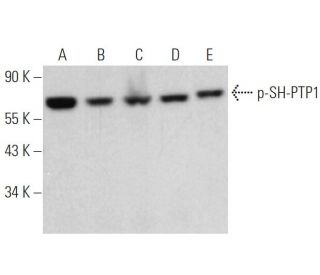


p-SH-PTP1 Antibody (14.Tyr 536): sc-135780
- p-SH-PTP1 Antibody (14.Tyr 536) is a mouse monoclonal IgG1 κ, cited in 1 publications, provided at 200 µg/ml
- raised against a short amino acid sequence containing phosphorylated Tyr 536 of SH-PTP1 of human origin
- recommended for detection of Tyr 536 phosphorylated SH-PTP1 of mouse, rat and human origin by WB, IP and ELISA
- m-IgGκ BP-HRP is the preferred secondary detection reagent for p-SH-PTP1 Antibody (14.Tyr 536) for WB applications. This reagent is now offered in a bundle with p-SH-PTP1 Antibody (14.Tyr 536) (see ordering information below). For additional m-IgGκ BP conjugates see our complete list of Mouse IgG Binding Proteins.

p-SH-PTP1 Antibody (14.Tyr 536) is a mouse monoclonal IgG1 antibody that detects p-SH-PTP1 in mouse, rat, and human samples through applications such as western blotting (WB), immunoprecipitation (IP), and enzyme-linked immunosorbent assay (ELISA). p-SH-PTP1, also known as SH-PTP1 or PTP1C, plays a crucial role in regulating cellular signaling pathways by modulating the phosphorylation state of tyrosine residues on proteins, which is essential for maintaining cellular homeostasis and responding to external stimuli. p-SH-PTP1 is primarily localized in hematopoietic cells, where anti-p-SH-PTP1 antibody (14.Tyr 536) recognizes a non-transmembrane protein tyrosine phosphatase, characterized by two SH2 domains that facilitate interaction with phosphotyrosine-containing sites on activated receptors. The presence of these SH2 domains enables p-SH-PTP1 to regulate the activity of various signaling molecules, thereby influencing processes such as cell growth, differentiation, and immune responses. The ability of p-SH-PTP1 to interact with specific substrates underscores its importance in the intricate balance of tyrosine phosphorylation, which is vital for proper cellular function and signaling. With broad species reactivity and proven applications, p-SH-PTP1 monoclonal antibody (14.Tyr 536) serves as an invaluable tool for researchers studying the dynamics of tyrosine phosphorylation and its implications in various biological processes.
Alexa Fluor® is a trademark of Molecular Probes Inc., OR., USA
LI-COR® and Odyssey® are registered trademarks of LI-COR Biosciences
p-SH-PTP1 Antibody (14.Tyr 536) References:
- Identification of a human src homology 2-containing protein-tyrosine-phosphatase: a putative homolog of Drosophila corkscrew. | Freeman, RM., et al. 1992. Proc Natl Acad Sci U S A. 89: 11239-43. PMID: 1280823
- Characterization of hematopoietic intracellular protein tyrosine phosphatases: description of a phosphatase containing an SH2 domain and another enriched in proline-, glutamic acid-, serine-, and threonine-rich sequences. | Matthews, RJ., et al. 1992. Mol Cell Biol. 12: 2396-405. PMID: 1373816
- A protein-tyrosine phosphatase with sequence similarity to the SH2 domain of the protein-tyrosine kinases. | Shen, SH., et al. 1991. Nature. 352: 736-9. PMID: 1652101
- Protein tyrosine phosphatase containing SH2 domains: characterization, preferential expression in hematopoietic cells, and localization to human chromosome 12p12-p13. | Yi, TL., et al. 1992. Mol Cell Biol. 12: 836-46. PMID: 1732748
- Isolation of a src homology 2-containing tyrosine phosphatase. | Plutzky, J., et al. 1992. Proc Natl Acad Sci U S A. 89: 1123-7. PMID: 1736296
- Cloning of a cDNA for a major human protein-tyrosine-phosphatase. | Chernoff, J., et al. 1990. Proc Natl Acad Sci U S A. 87: 2735-9. PMID: 2157211
- Valproic acid increases NO production via the SH-PTP1-CDK5-eNOS-Ser(116) signaling cascade in endothelial cells and mice. | Cho, DH., et al. 2014. Free Radic Biol Med. 76: 96-106. PMID: 25150199
- Activation of a phosphotyrosine phosphatase by tyrosine phosphorylation. | Vogel, W., et al. 1993. Science. 259: 1611-4. PMID: 7681217
- SH2-containing phosphotyrosine phosphatase as a target of protein-tyrosine kinases. | Feng, GS., et al. 1993. Science. 259: 1607-11. PMID: 8096088
- Lck-dependent tyrosyl phosphorylation of the phosphotyrosine phosphatase SH-PTP1 in murine T cells. | Lorenz, U., et al. 1994. Mol Cell Biol. 14: 1824-34. PMID: 8114715
Ordering Information
| Product Name | Catalog # | UNIT | Price | Qty | FAVORITES | |
p-SH-PTP1 Antibody (14.Tyr 536) | sc-135780 | 200 µg/ml | $322.00 | |||
p-SH-PTP1 Antibody (14.Tyr 536): m-IgGκ BP-HRP Bundle | sc-521302 | 200 µg Ab, 40 µg BP | $361.00 |