
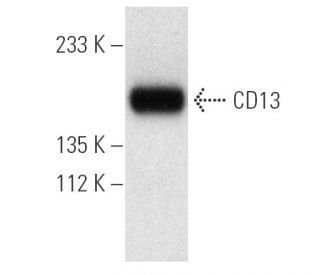
CD13 항체 (3D8): sc-13536
- CD13 항체 3D8 는 마우스 monoclonal IgG2a κ CD13 항체, 28간행물에 인용, 이며 200 µg/ml으로 제공합니다.
- human 골수성 세포에 대해 양성 반응
- CD13 항체 (3D8)는 WB, IP, IF and IHC(P)으로 mouse, rat and human유래의 myleiod cell CD13 를 감지하는 데에 추천한다.
- 항-CD13 항체(3D8)는 IP용 agarose와 결합되어 이용 가능하며, WB, IHC(P), ELISA용 HRP와 결합되어 이용 가능하며, IF, IHC(P), FCM용 phycoerythrin 또는 FITC와 결합되어 이용 가능합니다.
- WB (RGB), IF, IHC(P) 와FCM, RGB fluorescent imaging systems, such as iBright™ FL1000, FluorChem™, Typhoon, Azure and other comparable systems에 사용가능한 Alexa Fluor® 488, Alexa Fluor® 546, Alexa Fluor® 594 or Alexa Fluor® 647결합제품도 있습니다.
- WB (NIR), IF와FCM,Near-Infrared (NIR) detection systems, such as LI-COR®Odyssey®, iBright™ FL1000, FluorChem™, Typhoon, Azure and other comparable systems에 사용가능한 Alexa Fluor® 680 or Alexa Fluor® 790 결합제품도 있습니다.
- m-IgG Fc BP-HRP 및 2a BP-HRP">m-IgG2a BP-HRP 는 CD13 항체 (3D8) WB 및 IHC(P) 애플리케이션용입니다. 이 시약은 이제 CD13 항체 (3D8)와 함께 번들로 제공됩니다(아래 주문 정보 참조).

빠른 링크
더보기
CD13 항체(3D8)는 마우스, 랫트, 인간에서 유래된 CD13 단백질을 웨스턴 블롯(WB), 면역침전(IP), 면역형광(IF), 면역조직화학(IHC)을 통해 검출하는 마우스 단일클론 IgG2a 카파 경쇄 항체입니다. 항-CD13 항체(3D8)는 비결합 형태와 아가로스, 과산화효소(HRP), 피코에리트린(PE), 플루오레세인 이소티오시아네이트(FITC), 다중 알렉사 플루오르® 결합체 등 다양한 결합체 형태로 제공됩니다. CD13은 아미노펩티다제 N으로도 알려져 있으며, 주로 단핵구, 호염기구, 호산구, 호중구와 같은 골수성 세포와 골수성 백혈병에서 발현되는 II형 막관통 당단백질이며, 특정 상피세포, 섬유세포, 파골세포에서도 발현됩니다. CD13은 아연 결합 메탈로프로테아제로서, 펩타이드의 분해와 통증 조절과 스트레스 반응에 중요한 역할을 하는 엔케팔린과 같은 조절 펩타이드의 비활성화에 중요한 역할을 합니다. 암세포에 CD13이 존재하는 것은 침습 능력과 전이성 행동의 증가와 관련이 있으며, 따라서 CD13은 치료적 개입의 잠재적 표적이 될 수 있습니다. 특히, 인간 흑색종 세포에서 CD13 발현은 기본 섬유 아세포 성장 인자(bFGF)에 의해 조절될 수 있으며, 이는 골수성 및 상피성 CD13 프로모터를 활성화하여 암 생물학에서 CD13의 중요성과 종양 진행에 대한 바이오마커로서의 잠재력을 강조합니다.
Alexa Fluor®는 미국 오리건주 Molecular Probes Inc.의 상표입니다.
LI-COR®와 Odyssey®는 LI-COR Biosciences의 등록 상표입니다.
CD13 항체 (3D8) 참고문헌:
- CD-13('gp150'; 아미노펩티다제-N): 내피 및 조혈 세포에서 공동 발현하며 기능적 활성이 보존됩니다. | Favaloro, EJ. 1991. Immunol Cell Biol. 69 (Pt 4): 253-60. PMID: 1723966
- 인간 골수성 항원(gp160,95; gp150; gp67)의 추가 특성화: CD-11b, CD-13 및 CD-33에 속하는 단일 클론 항체 패널을 사용하여 에피토픽 이질성 및 비조혈 분포를 조사합니다. | Favaloro, EJ., et al. 1988. Br J Haematol. 69: 163-71. PMID: 2455535
- CD13/아미노펩티다아제 N은 염증성 질환의 잠재적 치료 표적입니다. | Lu, C., et al. 2020. J Immunol. 204: 3-11. PMID: 31848300
- CD13과 TIM3을 표적으로 하는 이중 특이성 및 분할 CAR T 세포는 급성 골수성 백혈병을 근절합니다. | He, X., et al. 2020. Blood. 135: 713-723. PMID: 31951650
- 암에서 엑토펩티다제 APN/CD13의 역할. | Lendeckel, U., et al. 2023. Biomedicines. 11: PMID: 36979703
- CD13은 면역세포의 이동을 촉진하고 급성 손상을 악화시키지만, 만성 뇌졸중 후 회복을 촉진합니다. | Nguyen, JN., et al. 2023. J Neuroinflammation. 20: 232. PMID: 37817190
- 단클론 항체에 의해 확인된 인간 골수 분화 항원: 백혈병 세포에서의 발현. | Bradstock, KF., et al. 1985. Pathology. 17: 392-9. PMID: 3865147
- 새로운 쌍을 이루는 CD13 음성(MT-50.1) 및 CD13 양성(MT-50.4) HTLV-1에 감염된 T세포주로서, 조절 T세포와 유사한 활성을 나타내는 차이가 있음. | Egawa, Y., et al. 2024. Sci Rep. 14: 12549. PMID: 38822041
- 경피증 섬유증에 대한 새로운 치료적 접근으로서 CD13/아미노펩티다제 N을 표적으로 삼는 것. | Muraoka, S., et al. 2025. Arthritis Rheumatol. 77: 80-91. PMID: 39175116
- 단일 클론 항체에 의해 확인된 골수성 전구세포 표면 항원. | Bradstock, KF., et al. 1985. Br J Haematol. 61: 11-20. PMID: 4052321
- CD13(GP150; 아미노펩티다제-N): 혈액에서 우세한 기능적 활성은 혈장에 국한되어 있으며 세포 표면과 관련이 없습니다. | Favaloro, EJ., et al. 1993. Exp Hematol. 21: 1695-701. PMID: 7902291
- 간담도 질환 마커 혈청 알라닌 아미노펩티다제는 주로 혈액 골수 분화 항원 및 백혈병 마커 CD-13/gp150의 이소형으로 구성됩니다. | Favaloro, EJ., et al. 1993. Clin Chim Acta. 220: 81-90. PMID: 7904544
주문정보
| 제품명 | 카탈로그 번호 | 단위 | 가격 | 수량 | 관심품목 | |
CD13 항체 (3D8) | sc-13536 | 200 µg/ml | $322.00 | |||
CD13 (3D8): m-IgG Fc BP-HRP 번들 | sc-525475 | 200 µg Ab; 10 µg BP | $361.00 | |||
CD13 (3D8): m-IgG2a BP-HRP 번들 | sc-546276 | 200 µg Ab; 10 µg BP | $361.00 | |||
CD13 항체 (3D8) AC | sc-13536 AC | 500 µg/ml, 25% agarose | $424.00 | |||
CD13 항체 (3D8) HRP | sc-13536 HRP | 200 µg/ml | $322.00 | |||
CD13 항체 (3D8) FITC | sc-13536 FITC | 200 µg/ml | $336.00 | |||
CD13 항체 (3D8) PE | sc-13536 PE | 200 µg/ml | $349.00 | |||
CD13 항체 (3D8) Alexa Fluor® 488 | sc-13536 AF488 | 200 µg/ml | $364.00 | |||
CD13 항체 (3D8) Alexa Fluor® 546 | sc-13536 AF546 | 200 µg/ml | $364.00 | |||
CD13 항체 (3D8) Alexa Fluor® 594 | sc-13536 AF594 | 200 µg/ml | $364.00 | |||
CD13 항체 (3D8) Alexa Fluor® 647 | sc-13536 AF647 | 200 µg/ml | $364.00 | |||
CD13 항체 (3D8) Alexa Fluor® 680 | sc-13536 AF680 | 200 µg/ml | $364.00 | |||
CD13 항체 (3D8) Alexa Fluor® 790 | sc-13536 AF790 | 200 µg/ml | $364.00 |