
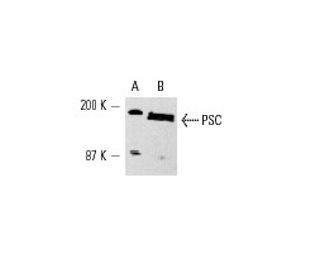

Bmi-1 Antibody (1F4): sc-13519
- Bmi-1 Antibody (1F4) is a mouse monoclonal IgG2a κ, cited in 4 publications, provided at 200 µg/ml
- raised against Bmi-1 fusion protein of Drosophila melanogaster origin
- Bmi-1 Antibody (1F4) is recommended for detection of Bmi-1 of mouse and Drosophila origin, and PSC of Drosophila origin of mouse and Drosophila origin by WB, IP and IF
- Anti-Bmi-1 Antibody (1F4) is available conjugated to agarose for IP; HRP for WB, IHC(P) and ELISA; and to either phycoerythrin or FITC for IF, IHC(P) and FCM
- also available conjugated to Alexa Fluor® 488, Alexa Fluor® 546, Alexa Fluor® 594 or Alexa Fluor® 647 for WB (RGB), IF, IHC(P) and FCM, and for use with RGB fluorescent imaging systems, such as iBright™ FL1000, FluorChem™, Typhoon, Azure and other comparable systems
- also available conjugated to Alexa Fluor® 680 or Alexa Fluor® 790 for WB (NIR), IF and FCM; for use with Near-Infrared (NIR) detection systems, such as LI-COR®Odyssey®, iBright™ FL1000, FluorChem™, Typhoon, Azure and other comparable systems
- TransCruz reagent for Gel Supershift and ChIP applications (sc-13519 X, 200 µg/0.1 ml)
- m-IgG Fc BP-HRP and m-IgG2a BP-HRP are the preferred secondary detection reagents for Bmi-1 Antibody (1F4) for WB applications. These reagents are now offered in bundles with Bmi-1 Antibody (1F4) (see ordering information below).

QUICK LINKS
SEE ALSO...
Bmi-1 Antibody (1F4) is a mouse monoclonal IgG2a kappa light chain antibody that detects Bmi-1 in mouse samples through applications such as western blotting (WB), immunoprecipitation (IP), and immunofluorescence (IF). Bmi-1 (1F4) monoclonal antibody is available in both non-conjugated and various conjugated forms, including agarose, horseradish peroxidase, phycoerythrin, fluorescein isothiocyanate, and multiple Alexa Fluor® conjugates. Bmi-1 plays a crucial role in regulating gene expression and is a key member of the Polycomb group proteins, which are essential for maintaining the repression of homeotic genes during embryonic development. Bmi-1 is primarily located in the nucleus, where Bmi-1 interacts with chromatin to modulate transcriptional activity. Nuclear localization of Bmi-1 is vital for function in gene silencing and cellular proliferation, as direct influence on chromatin structure and accessibility of target genes occurs. Notably, Bmi-1 has been implicated in the regulation of self-renewal and differentiation in stem cells, as well as in the development of various cancers, making Bmi-1 a significant focus of research in oncology and developmental biology. Interaction of Bmi-1 with other proteins, such as c-Myc and Pim, further underscores importance in oncogenic pathways and lymphomagenesis, highlighting the need for effective tools like Bmi-1 (1F4) antibody to study diverse roles in cellular processes.
Alexa Fluor® is a trademark of Molecular Probes Inc., OR., USA
LI-COR® and Odyssey® are registered trademarks of LI-COR Biosciences
Ordering Information
| Product Name | Catalog # | UNIT | Price | Qty | FAVORITES | |
Bmi-1 Antibody (1F4) | sc-13519 | 200 µg/ml | $322.00 | |||
Bmi-1 Antibody (1F4): m-IgG Fc BP-HRP Bundle | sc-525473 | 200 µg Ab; 10 µg BP | $361.00 | |||
Bmi-1 Antibody (1F4): m-IgG2a BP-HRP Bundle | sc-546274 | 200 µg Ab; 10 µg BP | $361.00 | |||
Bmi-1 Antibody (1F4) X | sc-13519 X | 200 µg/0.1 ml | $322.00 | |||
Bmi-1 Antibody (1F4) AC | sc-13519 AC | 500 µg/ml, 25% agarose | $424.00 | |||
Bmi-1 Antibody (1F4) HRP | sc-13519 HRP | 200 µg/ml | $322.00 | |||
Bmi-1 Antibody (1F4) FITC | sc-13519 FITC | 200 µg/ml | $336.00 | |||
Bmi-1 Antibody (1F4) PE | sc-13519 PE | 200 µg/ml | $349.00 | |||
Bmi-1 Antibody (1F4) Alexa Fluor® 488 | sc-13519 AF488 | 200 µg/ml | $364.00 | |||
Bmi-1 Antibody (1F4) Alexa Fluor® 546 | sc-13519 AF546 | 200 µg/ml | $364.00 | |||
Bmi-1 Antibody (1F4) Alexa Fluor® 594 | sc-13519 AF594 | 200 µg/ml | $364.00 | |||
Bmi-1 Antibody (1F4) Alexa Fluor® 647 | sc-13519 AF647 | 200 µg/ml | $364.00 | |||
Bmi-1 Antibody (1F4) Alexa Fluor® 680 | sc-13519 AF680 | 200 µg/ml | $364.00 | |||
Bmi-1 Antibody (1F4) Alexa Fluor® 790 | sc-13519 AF790 | 200 µg/ml | $364.00 |