
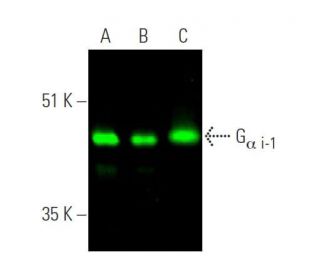

Questo anticorpo policlonale è stato sospeso. Consulta il nostro anticorpo monoclonale Gα i-1/GNAI1 (R4) raccomandato (sono riportati i dati del campione).
Anticorpo Gα i/o/t/z (D-15): sc-12798
- G alpha i/o/t/z Antibody D-15è un policlonale di capra IgG fornito in 200 µg/ml
- epitopo mappato nella regione interna di Gα o di origine human
- Anticorpo policlonale fuori produzione

Solo per ricerca in vitro. Non destinato ad uso Diagnostico o Terapeutico.
Alexa Fluor® è un marchio registrato di Molecular Probes Inc., OR., USA
Informazioni ordini
Gα i-1/GNAI1 (R4): sc-13533 [ Monoclonale raccomandato come sostituzione per Gα i/o/t/z (D-15) ]
| Nome del prodotto | Codice del prodotto | UNITÀ | Prezzo | Quantità | Preferiti | |
Gα i-1/GNAI1 Anticorpo (R4) | sc-13533 | 200 µg/ml | $322.00 | |||
Gα i-1/GNAI1 (R4): m-IgG Fc BP-HRP Bundle | sc-528286 | 200 µg Ab; 10 µg BP | $361.00 | |||
Gα i-1/GNAI1 (R4): m-IgGκ BP-HRP Bundle | sc-520625 | 200 µg Ab, 40 µg BP | $361.00 | |||
Gα i-1/GNAI1 (R4): m-IgG2b BP-HRP Bundle | sc-550024 | 200 µg Ab; 10 µg BP | $361.00 | |||
Gα i-1/GNAI1 Anticorpo (R4) AC | sc-13533 AC | 500 µg/ml, 25% agarose | $424.00 | |||
Gα i-1/GNAI1 Anticorpo (R4) HRP | sc-13533 HRP | 200 µg/ml | $322.00 | |||
Gα i-1/GNAI1 Anticorpo (R4) FITC | sc-13533 FITC | 200 µg/ml | $336.00 | |||
Gα i-1/GNAI1 Anticorpo (R4) PE | sc-13533 PE | 200 µg/ml | $349.00 | |||
Gα i-1/GNAI1 Anticorpo (R4) Alexa Fluor® 488 | sc-13533 AF488 | 200 µg/ml | $364.00 | |||
Gα i-1/GNAI1 Anticorpo (R4) Alexa Fluor® 546 | sc-13533 AF546 | 200 µg/ml | $364.00 | |||
Gα i-1/GNAI1 Anticorpo (R4) Alexa Fluor® 594 | sc-13533 AF594 | 200 µg/ml | $364.00 | |||
Gα i-1/GNAI1 Anticorpo (R4) Alexa Fluor® 647 | sc-13533 AF647 | 200 µg/ml | $364.00 | |||
Gα i-1/GNAI1 Anticorpo (R4) Alexa Fluor® 680 | sc-13533 AF680 | 200 µg/ml | $364.00 | |||
Gα i-1/GNAI1 Anticorpo (R4) Alexa Fluor® 790 | sc-13533 AF790 | 200 µg/ml | $364.00 |