
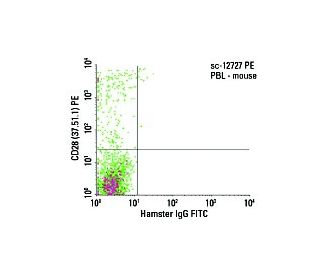

CD28 Antibody (37.51.1): sc-12727
- CD28 Antibody (37.51.1) is a Syrian hamster monoclonal IgG, cited in 2 publications, provided at 200 µg/ml
- raised against the extracellular domain of CD28 of mouse origin
- recommended for detection of CD28 of mouse origin by IP, IF and FCM
- available conjugated to either phycoerythrin or FITC for IF, IHC(P) and FCM
- also provided azide-free for T-Cell Activation, sc-12727 L, 200 µg/0.1 ml
- At present, we have not yet completed the identification of the preferred secondary detection reagent(s) for CD28 Antibody (37.51.1). This work is in progress.

QUICK LINKS
SEE ALSO...
CD28 Antibody (37.51.1) is a hamster monoclonal IgG antibody that detects CD28 in mouse samples through applications such as immunoprecipitation (IP), immunofluorescence (IF), and flow cytometry (FCM). CD28 plays a crucial role in T cell activation and survival by providing essential co-stimulatory signals upon binding to CD80 and CD86 ligands, which are expressed on antigen-presenting cells. This interaction is vital for the full activation of T cells, as CD28 enhances their proliferation and cytokine production, ultimately influencing the adaptive immune response. The structure of CD28 is particularly important, as CD28 contains a single immunoglobulin-like domain and a cytoplasmic tail that is essential for signaling. Upon engagement with CD28 ligands, CD28 recruits various signaling molecules, leading to the activation of pathways that promote T cell survival and function. The ability of CD28 to enhance T cell responses makes CD28 a critical target for therapeutic interventions in various diseases, including cancer and autoimmune disorders. Anti-CD28 antibody (37.51.1) is an invaluable tool for researchers studying T cell biology and the mechanisms of immune regulation.
Alexa Fluor® is a trademark of Molecular Probes Inc., OR., USA
LI-COR® and Odyssey® are registered trademarks of LI-COR Biosciences
CD28 Antibody (37.51.1) References:
- Two pathways of costimulation through CD28. | Miller, J., et al. 2009. Immunol Res. 45: 159-72. PMID: 19214786
- Regulation of NF-κB induction by TCR/CD28. | Cheng, J., et al. 2011. Immunol Res. 50: 113-7. PMID: 21717079
- F-Actin-Driven CD28-CD80 Localization in the Immune Synapse. | Siokis, A., et al. 2018. Cell Rep. 24: 1151-1162. PMID: 30067972
- The CD28 Transmembrane Domain Contains an Essential Dimerization Motif. | Leddon, SA., et al. 2020. Front Immunol. 11: 1519. PMID: 32765524
- The CD28-Transmembrane Domain Mediates Chimeric Antigen Receptor Heterodimerization With CD28. | Muller, YD., et al. 2021. Front Immunol. 12: 639818. PMID: 33833759
- Immunological lessons from CD28 deficiency in humans. | Wieland, A. and Ahmed, R. 2021. Cell. 184: 3595-3597. PMID: 34242561
- SNX9-induced membrane tubulation regulates CD28 cluster stability and signalling. | Ecker, M., et al. 2022. Elife. 11: PMID: 35050850
- Excessive IL-15 promotes cytotoxic CD4 + CD28- T cell-mediated renal injury in lupus nephritis. | Zhang, T., et al. 2022. Immun Ageing. 19: 50. PMID: 36320075
- Selective CD28 blockade impacts T cell differentiation during homeostatic reconstitution following lymphodepletion. | Habib, JG., et al. 2022. Front Immunol. 13: 1081163. PMID: 36761170
- Cytomegalovirus Infection Facilitates the Costimulation of CD57+CD28- CD8 T Cells in HIV Infection and Atherosclerosis via the CD2-LFA-3 Axis. | Winchester, NE., et al. 2024. J Immunol. 212: 245-257. PMID: 38047900
Ordering Information
| Product Name | Catalog # | UNIT | Price | Qty | FAVORITES | |
CD28 Antibody (37.51.1) | sc-12727 | 200 µg/ml | $322.00 | |||
CD28 Antibody (37.51.1) FITC | sc-12727 FITC | 200 µg/ml | $336.00 | |||
CD28 Antibody (37.51.1) L | sc-12727 L | 200 µg/0.1 ml | $322.00 | |||
CD28 Antibody (37.51.1) PE | sc-12727 PE | 200 µg/ml | $349.00 |