
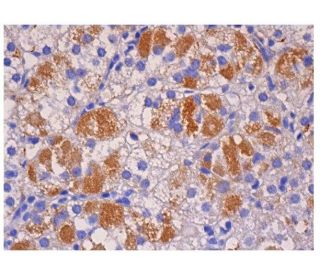
CLIP Antibody (cerCLIP.1): sc-12725
- CLIP Antibody (cerCLIP.1) is a mouse monoclonal IgG1 κ, cited in 14 publications, provided at 200 µg/ml
- epitope mapping to amino acids 81-104 of class II invariant chain peptide (CLIP) of HLA-DR of human origin
- Anti-CLIP Antibody (cerCLIP.1) is recommended for detection of CLIP of mouse, rat and human origin by WB, IP, IF, IHC(P) and FCM
- Anti-CLIP Antibody (cerCLIP.1) is available conjugated to agarose for IP; HRP for WB, IHC(P) and ELISA; and to either phycoerythrin or FITC for IF, IHC(P) and FCM
- also available conjugated to Alexa Fluor® 488, Alexa Fluor® 546, Alexa Fluor® 594 or Alexa Fluor® 647 for WB (RGB), IF, IHC(P) and FCM, and for use with RGB fluorescent imaging systems, such as iBright™ FL1000, FluorChem™, Typhoon, Azure and other comparable systems
- also available conjugated to Alexa Fluor® 680 or Alexa Fluor® 790 for WB (NIR), IF and FCM; for use with Near-Infrared (NIR) detection systems, such as LI-COR®Odyssey®, iBright™ FL1000, FluorChem™, Typhoon, Azure and other comparable systems
- m-IgG Fc BP-HRP is the preferred secondary detection reagent for CLIP Antibody (cerCLIP.1) for WB and IHC(P) applications. This reagent is now offered in a bundle with CLIP Antibody (cerCLIP.1) (see ordering information below).

QUICK LINKS
CLIP Antibody (cerCLIP.1) is a mouse monoclonal IgG1 kappa light chain antibody that detects CLIP in mouse, rat, and human samples through applications such as western blotting (WB), immunoprecipitation (IP), immunofluorescence (IF), immunohistochemistry with paraffin-embedded sections (IHCP), and flow cytometry (FCM). CLIP (cerCLIP.1) antibody is available in both non-conjugated and various conjugated forms, including agarose, horseradish peroxidase (HRP), phycoerythrin (PE), fluorescein isothiocyanate (FITC), and multiple Alexa Fluor® conjugates. CLIP plays a crucial role in the immune response by acting as a residual fragment of the invariant chain that remains in the peptide-binding groove of major histocompatibility complex (MHC) class II molecules after the invariant chains are degraded. This function is vital as CLIP allows for the proper loading of antigenic peptides onto MHC class II molecules, which are essential for T cell recognition and activation. The exchange of CLIP for processed peptides is facilitated by the non-classical human leukocyte antigen HLA-DM, which not only removes CLIP but also ensures that MHC class II molecules are loaded with the appropriate peptides for effective immune presentation. Anti-CLIP antibody (cerCLIP.1) exhibits strong reactivity with surface class II-CLIP complexes, making CLIP (cerCLIP.1) monoclonal antibody an invaluable tool for identifying HLA class II-positive cells, cells with impaired HLA-DM activity, and tumor cells that have evaded detection by CD4-positive T cells.
Alexa Fluor® is a trademark of Molecular Probes Inc., OR., USA
LI-COR® and Odyssey® are registered trademarks of LI-COR Biosciences
CLIP Antibody (cerCLIP.1) References:
- Nonclassical MHC class II molecules. | Alfonso, C. and Karlsson, L. 2000. Annu Rev Immunol. 18: 113-42. PMID: 10837054
- HLA-DR molecules from an antigen-processing mutant cell line are associated with invariant chain peptides. | Riberdy, JM., et al. 1992. Nature. 360: 474-7. PMID: 1448172
- CD74: an emerging opportunity as a therapeutic target in cancer and autoimmune disease. | Borghese, F. and Clanchy, FI. 2011. Expert Opin Ther Targets. 15: 237-51. PMID: 21208136
- CD74 is a novel transcription regulator. | Gil-Yarom, N., et al. 2017. Proc Natl Acad Sci U S A. 114: 562-567. PMID: 28031488
- Role of MIF1/MIF2/CD74 interactions in bladder cancer. | Woolbright, BL., et al. 2023. J Pathol. 259: 46-55. PMID: 36214539
- CD74 Promotes a Pro-Inflammatory Tumor Microenvironment by Inducing S100A8 and S100A9 Secretion in Pancreatic Cancer. | Hong, WC., et al. 2023. Int J Mol Sci. 24: PMID: 37629174
- The complete sequence of the mRNA for the HLA-DR-associated invariant chain reveals a polypeptide with an unusual transmembrane polarity. | Strubin, M., et al. 1984. EMBO J. 3: 869-72. PMID: 6586420
- HLA-DM induces CLIP dissociation from MHC class II alpha beta dimers and facilitates peptide loading. | Denzin, LK. and Cresswell, P. 1995. Cell. 82: 155-65. PMID: 7606781
- Transport and intracellular distribution of MHC class II molecules and associated invariant chain in normal and antigen-processing mutant cell lines. | Riberdy, JM., et al. 1994. J Cell Biol. 125: 1225-37. PMID: 8207055
- Out damned CLIP! Out, I say! | Roche, PA. 1996. Science. 274: 526-7. PMID: 8928005
- Negative regulation by HLA-DO of MHC class II-restricted antigen processing. | Denzin, LK., et al. 1997. Science. 278: 106-9. PMID: 9311912
- Structure of a trimeric domain of the MHC class II-associated chaperonin and targeting protein Ii. | Jasanoff, A., et al. 1998. EMBO J. 17: 6812-8. PMID: 9843486
Ordering Information
| Product Name | Catalog # | UNIT | Price | Qty | FAVORITES | |
CLIP Antibody (cerCLIP.1) | sc-12725 | 200 µg/ml | $322.00 | |||
CLIP Antibody (cerCLIP.1): m-IgG Fc BP-HRP Bundle | sc-525461 | 200 µg Ab; 10 µg BP | $361.00 | |||
CLIP Antibody (cerCLIP.1) AC | sc-12725 AC | 500 µg/ml, 25% agarose | $424.00 | |||
CLIP Antibody (cerCLIP.1) HRP | sc-12725 HRP | 200 µg/ml | $322.00 | |||
CLIP Antibody (cerCLIP.1) FITC | sc-12725 FITC | 200 µg/ml | $336.00 | |||
CLIP Antibody (cerCLIP.1) PE | sc-12725 PE | 200 µg/ml | $349.00 | |||
CLIP Antibody (cerCLIP.1) Alexa Fluor® 488 | sc-12725 AF488 | 200 µg/ml | $364.00 | |||
CLIP Antibody (cerCLIP.1) Alexa Fluor® 546 | sc-12725 AF546 | 200 µg/ml | $364.00 | |||
CLIP Antibody (cerCLIP.1) Alexa Fluor® 594 | sc-12725 AF594 | 200 µg/ml | $364.00 | |||
CLIP Antibody (cerCLIP.1) Alexa Fluor® 647 | sc-12725 AF647 | 200 µg/ml | $364.00 | |||
CLIP Antibody (cerCLIP.1) Alexa Fluor® 680 | sc-12725 AF680 | 200 µg/ml | $364.00 | |||
CLIP Antibody (cerCLIP.1) Alexa Fluor® 790 | sc-12725 AF790 | 200 µg/ml | $364.00 |