
 |
- goat polyclonal IgG, 200 µg/ml
- epitope mapping near the C-terminus of Akt3 of mouse origin
- recommended for detection of Akt3 of mouse, rat, and, to a lesser extent, human origin by WB, IP, IF and ELISA
- blocking peptide, sc-11521 P
|
|
| |
Ordering InformationProduct Citations
Recommended Support Products:
(click button of application of choice)
Akt3 Background Information The serine/threonine kinase Akt family contains several members, including Akt1 (also designated PKB or RacPK), Akt2 (also designated PKB∫ or RacPK-∫) and Akt 3 (also designated PKB© or thyoma viral proto-oncogene 3), which exhibit sequence homology with the protein kinase A and C families and are encoded by the c-Akt proto-oncogene. All members of the Akt family have a pleckstrin homology domain. Akt3 is phosphorylated on a serine residue in response to insulin. However, the activation of Akt3 by insulin is inhibited by prior activation of protein kinase C via a mechanism that does not require the presence of the PH domain. Akt3 is expressed in 3T3-L1 fibroblasts, adipocytes and skeletal muscle and may be involved in various biological processes, including adipocyte and muscle differentiation, glycogen synthesis, glucose uptake, apoptosis and cellular proliferation.
| Akt3 (M-14) Product Citations |
See how others have used Akt3 (M-14): sc-11521 antibody and or Akt3 (M-14) antibody conjugates.
3 total citations Loading citations.
|
| |
|
 |
|
Akt3 (M-14)
Click on image to enlarge
|
|
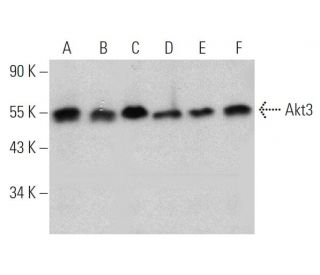
Akt3 (M-14): sc-11521. Western blot analysis of Akt3 expression in mouse brain tissue extract.
Akt3 (M-14): sc-11521. Western blot analysis of Akt3 expression in non-transfected: sc-117752 (A) and human Akt3 transfected: sc-127955 (B) 293T whole cell lysates and mouse brain tissue extract (C).
|
|
Download
|
|
