
TAP1 Background Information The transporter associated with antigen processing (TAP) is a member of the ATP-binding cassette (ABC) family of transmembrane transporters and is an essential component of the major histocompatability complex (MHC) class I antigen-presenting pathway (1). TAP consists of two structurally related subunits, TAP1 and TAP2, that associate into stable dimers and together they form a translocation pore for peptides in the endoplasmic reticulum (ER) membranes (2,3). The functional TAP transporter facilitates the translocation of peptides from the cytosol into the ER lumen for presentation to MHC class I molecules (4). Structurally, TAP1 and TAP2 contain an N-terminal transmembrane (TM) region, which together forms the TM pore, and a cytoplasmic peptide-binding pocket (5,6). In addition, the TAP transporter also contains several C-terminal nucleotide-binding domains (NBD), which bind and hydrolyze ATP and in turn, induce structural changes at the membrane to allow the passage of substrates into the ER (7).
TAP1 (M-18) Product Citations
See how others have used TAP1 (M-18): sc-11465 antibody and or TAP1 (M-18) antibody conjugates.
7 total citations
Loading citations.
TAP1 (M-18)
Click on image to enlarge
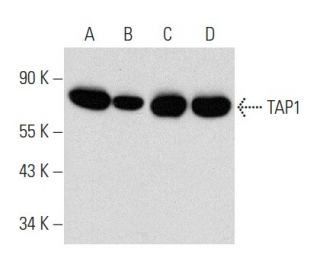
TAP1 (M-18): sc-11465. Western blot analysis of TAP1 expression in untreated (A) and IFN-γ-treated (B) RAW 264.7 whole cell lysates.
TAP1 (M-18): sc-11465. Western blot analysis of TAP1 expression in IFN-γ-treated RAW 264.7 whole cell lysate.
TAP1 (M-18): sc-11465. Immunofluorescence staining of methanol-fixed HeLa cells showing cytoplasmic localization.
