
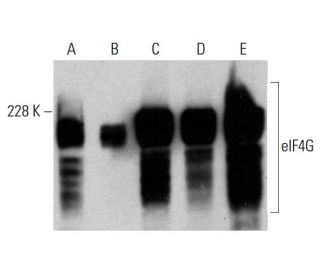

このポリクローナル抗体は販売終了となりました。弊社推奨のeIF4G (A-10)モノクローナル抗体をご覧ください(サンプルデータを表示)。

試験・研究用以外には使用しないでください。 臨床及び体外診断には使用できません。
Alexa Fluor® はMolecular Probes Inc., OR., USAの商標です。
注文情報
eIF4G (A-10): sc-133155 [ eIF4G (H-300) の強くお勧めのモノクローナル抗体の代替品]
| 製品名 | カタログ # | 単位 | 価格 | 数量 | お気に入り | |
eIF4G 抗体 (A-10) | sc-133155 | 200 µg/ml | $322.00 | |||
eIF4G (A-10): m-IgG Fc BP-HRP Bundle | sc-528755 | 200 µg Ab; 10 µg BP | $361.00 | |||
eIF4G (A-10): m-IgGκ BP-HRP Bundle | sc-521254 | 200 µg Ab, 40 µg BP | $361.00 | |||
eIF4G (A-10): m-IgG2b BP-HRP Bundle | sc-550069 | 200 µg Ab; 10 µg BP | $361.00 | |||
eIF4G 抗体 (A-10) AC | sc-133155 AC | 500 µg/ml, 25% agarose | $424.00 | |||
eIF4G 抗体 (A-10) HRP | sc-133155 HRP | 200 µg/ml | $322.00 | |||
eIF4G 抗体 (A-10) FITC | sc-133155 FITC | 200 µg/ml | $336.00 | |||
eIF4G 抗体 (A-10) PE | sc-133155 PE | 200 µg/ml | $349.00 | |||
eIF4G 抗体 (A-10) Alexa Fluor® 488 | sc-133155 AF488 | 200 µg/ml | $364.00 | |||
eIF4G 抗体 (A-10) Alexa Fluor® 546 | sc-133155 AF546 | 200 µg/ml | $364.00 | |||
eIF4G 抗体 (A-10) Alexa Fluor® 594 | sc-133155 AF594 | 200 µg/ml | $364.00 | |||
eIF4G 抗体 (A-10) Alexa Fluor® 647 | sc-133155 AF647 | 200 µg/ml | $364.00 | |||
eIF4G 抗体 (A-10) Alexa Fluor® 680 | sc-133155 AF680 | 200 µg/ml | $364.00 | |||
eIF4G 抗体 (A-10) Alexa Fluor® 790 | sc-133155 AF790 | 200 µg/ml | $364.00 |