
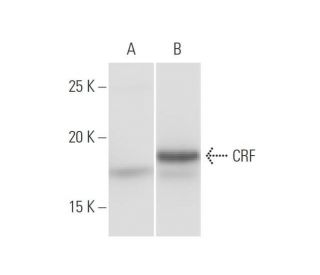
CRF Background Information
Individuals suffering from Alzheimer’s disease (AD) exhibit dramatic reductions in the content of corticotropin-releasing factor (CRF), increased expression of CRF receptors (CRFRs) and abnormalities in neuronal morphology in affected brain areas (1). In addition, AD patients show decreased concentrations of CRF in their cerebrospinal fluid, which may contribute to their cognitive impairment (1). A high affinity CRF binding protein, designated CRF-BP, has been discovered in post-mortem brain samples from AD patients (1-3). CRF-BP serves to bind and inactivate CRF, reducing the pool of “free CRF” available to bind CRFRs (2,3). Two CRFRs, designated CRF-RI and CFR-RII, have been described and exhibit distinct brain localizations (4,5). There are two forms of CFR-RII, referred to as CFR-RII å and CFR-RII ß, that result from alternative mRNA splicings (6). An additional member of the CRF family, urocortin, shares 63% sequence identity with urotensin and 45% sequence identity with CRF (7). Urocortin specifically binds to and activates CRF-RI and CRF-RII, but binds to CRF-RII more efficiently than CRF, suggesting that it may be the true, high affinity ligand for the CRF receptor type II (7).
