
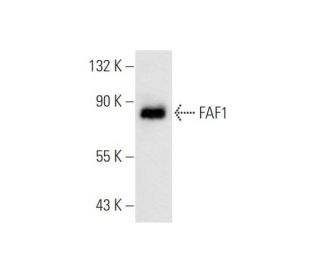


FAF1 Anticorpo (92-B): sc-101255
- FAF1 Anticorpo 92-Bé um anticorpo monoclonal produzido em camundongo mouse IgG1 κ (kappa light chain) fornecido em 100 µg/ml
- Produzido contra recombinante FAF1 de human origem
- recomendado para a detecção de FAF1 de mouse, rat e human origem em
- Atualmente, ainda não concluímos a identificação do(s) reagente(s) de deteção secundário(s) preferido(s) para FAF1 Anticorpo (92-B). Este trabalho está em curso.

LINKS RÁPIDOS
VEJA TAMBÉM
Em contraste com os factores de crescimento que promovem a proliferação celular, o ligando FAS (FAS-L) e os factores de necrose tumoral (TNF) induzem rapidamente a apoptose. A resposta celular ao FAS-L e ao TNF é mediada por receptores estruturalmente relacionados que contêm um "domínio de morte" conservado e pertencem à superfamília dos receptores do TNF. TRADD, FADD e RIP são proteínas de interação FAS/TNF-RI que contêm uma região homóloga ao domínio da morte (DDH). A TRADD (domínio de morte associado ao TNF-RI) e a FADD (domínio de morte associado ao FAS) associam-se aos domínios de morte do FAS e do TNF-RI através das suas regiões DDH, enquanto a RIP se associa exclusivamente ao FAS. Uma proteína adicional que interage com o FAS, designada FAF1, para o fator de proteína-1 associado ao FAS, liga-se à cauda citoplasmática do FAS de tipo selvagem, mas não do FAS mutante lpr. Quando sobreexpressa nas células, a FAF1 aumenta a eficiência da apoptose mediada pela FAS. Ao contrário da TRADD, da FADD e da RIP, a FAF1 não possui uma DDH e não pode induzir a apoptose independentemente da ativação da FAS.
Informacoes sobre ordens
| Nome do Produto | Numero de Catalogo | UNID | Preco | Qde | FAVORITOS | |
FAF1 Anticorpo (92-B) | sc-101255 | 100 µg/ml | $339.00 |