
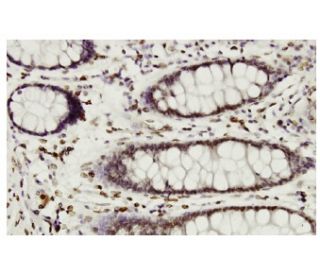
WDR20 Antibody (38K): sc-100900
- WDR20 Antibody (38K) is a mouse monoclonal IgG1 κ WDR20 antibody, cited in 2 publications, provided at 100 µg/ml
- raised against recombinant WDR20 of human origin
- recommended for detection of WDR20 of mouse, rat and human origin by WB, IP, IF, IHC(P) and ELISA
- m-IgG Fc BP-HRP and m-IgG1 BP-HRP are the preferred secondary detection reagents for WDR20 Antibody (38K) for WB and IHC(P) applications. These reagents are now offered in bundles with WDR20 Antibody (38K) (see ordering information below).

WDR20 Antibody (38K) is a mouse monoclonal IgG1 kappa light chain antibody that detects WDR20 protein of mouse, rat, and human origin by western blotting (WB), immunoprecipitation (IP), immunofluorescence (IF), immunohistochemistry with paraffin-embedded sections (IHCP), and enzyme-linked immunosorbent assay (ELISA). Anti-WDR20 antibody (38K) is available as the non-conjugated format. WDR20 protein, also known as WD-repeat-containing protein 20 or DMR, is a 569 amino acid protein characterized by the presence of five WD-repeats, which are structural motifs that typically form a tertiary propeller configuration. This unique structure facilitates WDR20′s involvement in various cellular processes, including chromatin assembly, cell cycle regulation, signal transduction, RNA processing, apoptosis, and vesicular trafficking. The presence of WD-repeats in WDR20 suggests a role in complex signaling networks within the cell, and the existence of two isoforms due to alternative splicing further highlights WDR20′s functional diversity. Anti-WDR20 antibody (38K) enables researchers to explore WDR20′s intricate roles in cellular mechanisms and potential implications in various biological contexts.
Alexa Fluor® is a trademark of Molecular Probes Inc., OR., USA
LI-COR® and Odyssey® are registered trademarks of LI-COR Biosciences
WDR20 Antibody (38K) References:
- The WD repeat: a common architecture for diverse functions. | Smith, TF., et al. 1999. Trends Biochem Sci. 24: 181-5. PMID: 10322433
- WD-repeat proteins: structure characteristics, biological function, and their involvement in human diseases. | Li, D. and Roberts, R. 2001. Cell Mol Life Sci. 58: 2085-97. PMID: 11814058
- The WD-40 repeat. | van der Voorn, L. and Ploegh, HL. 1992. FEBS Lett. 307: 131-4. PMID: 1644165
- Global, in vivo, and site-specific phosphorylation dynamics in signaling networks. | Olsen, JV., et al. 2006. Cell. 127: 635-48. PMID: 17081983
- WDR20 regulates activity of the USP12 x UAF1 deubiquitinating enzyme complex. | Kee, Y., et al. 2010. J Biol Chem. 285: 11252-7. PMID: 20147737
- Characterization of WDR20: A new regulator of the ERAD machinery. | Ju, LG., et al. 2018. Biochim Biophys Acta Mol Cell Res. 1865: 970-980. PMID: 29655804
- WDR20 regulates shuttling of the USP12 deubiquitinase complex between the plasma membrane, cytoplasm and nucleus. | Olazabal-Herrero, A., et al. 2019. Eur J Cell Biol. 98: 12-26. PMID: 30466959
- The USP46 complex deubiquitylates LRP6 to promote Wnt/β-catenin signaling. | Ng, VH., et al. 2023. Nat Commun. 14: 6173. PMID: 37798301
- WDR20 prevents hepatocellular carcinoma senescence by orchestrating the simultaneous USP12/46-mediated deubiquitination of c-Myc. | Jiang, L., et al. 2024. Proc Natl Acad Sci U S A. 121: e2407904121. PMID: 39432777
- The ancient regulatory-protein family of WD-repeat proteins. | Neer, EJ., et al. 1994. Nature. 371: 297-300. PMID: 8090199
- Folding of proteins with WD-repeats: comparison of six members of the WD-repeat superfamily to the G protein beta subunit. | Garcia-Higuera, I., et al. 1996. Biochemistry. 35: 13985-94. PMID: 8909296
- Folding a WD repeat propeller. Role of highly conserved aspartic acid residues in the G protein beta subunit and Sec13. | Garcia-Higuera, I., et al. 1998. J Biol Chem. 273: 9041-9. PMID: 9535892
Ordering Information
| Product Name | Catalog # | UNIT | Price | Qty | FAVORITES | |
WDR20 Antibody (38K) | sc-100900 | 100 µg/ml | $339.00 | |||
WDR20 Antibody (38K): m-IgG Fc BP-HRP Bundle | sc-539720 | 100 µg Ab; 10 µg BP | $361.00 | |||
WDR20 Antibody (38K): m-IgG1 BP-HRP Bundle | sc-541668 | 100 µg Ab; 20 µg BP | $361.00 |