
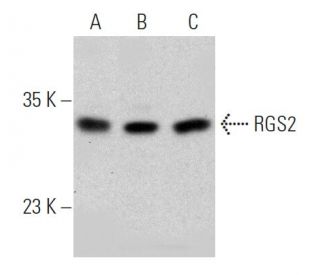
RGS2 抗体 (BC-43): sc-100761. HeLa (A), U-87 MG (B) 和 EOC 20 (C) 全细胞裂解液中 RGS2 表达的 Western 印迹分析.
RGS2 抗体 (BC-43): sc-100761
- RGS2 抗体 BC-43 是小鼠单克隆 IgG2a κ,RGS2抗体, 在10篇文献中引用,规格为100 µg/ml
- 针对部分重组蛋白,其氨基酸序列在RGS2的human起源的111-211范围内
- 推荐用于 mouse, rat 和 human 来源的RGS2 WB, IP, IF, IHC(P) 和 ELISA检测
- m-IgG Fc BP-HRP、 2a BP-HRP">m-IgG2a BP-HRP和m-IgGκ BP-HRP是RGS2 Antibody (BC-43) 适用于 WB 和 IHC(P) 应用。 的首选辅助检测试剂。这些试剂现与RGS2 Antibody (BC-43) 打包提供(请参阅下面的订购信息)。

RGS2抗体(BC-43)是一种小鼠单克隆IgG2a kappa轻链抗体,可通过蛋白质印迹(WB)、免疫沉淀(IP)、免疫荧光(IF)、石蜡包埋切片免疫组织化学(IHCP)和酶联免疫吸附测定(ELISA)检测小鼠、大鼠和人源RGS2蛋白。RGS2 (BC-43) 抗体以非结合形式提供。RGS2蛋白在调节G蛋白信号传导通路中起着至关重要的作用,特别是作为Gαq的GTP酶激活蛋白(GAP),对调节包括心血管功能和神经信号传导在内的各种生理过程至关重要。通过加速GTP水解为GDP,RGS2有效抑制Gαq活性,从而影响下游信号级联,影响细胞增殖、分化和对外部刺激的响应。RGS2对G蛋白信号的精确调节对于维持细胞稳态和预防高血压和心脏病等病理状况至关重要。通过与Gα亚型蛋白的特定相互作用,RGS2在细胞信号网络中扮演着关键角色,这使得抗RGS2抗体(BC-43)成为研究人员研究G蛋白偶联受体信号及其对健康和疾病的影响的宝贵工具。
仅限研究使用。不适用于诊断和治疗用途。
Alexa Fluor® 是Molecular Probes Inc., OR., USA的商标
LI-COR®和 Odyssey® 是LI-COR Biosciences的注册商标
RGS2 抗体 (BC-43) 参考文献:
- 不同的 beta 亚基决定了 G 蛋白与跨膜受体的相互作用。 | Kleuss, C., et al. 1992. Nature. 358: 424-6. PMID: 1322501
- G 蛋白 gamma 亚基的选择性组织分布,包括通过 cDNA 克隆发现的一种新形式的 gamma 亚基。 | Cali, JJ., et al. 1992. J Biol Chem. 267: 24023-7. PMID: 1385432
- 异三聚体 GTP 结合蛋白 beta 亚基的多样性:新型 beta 亚基 cDNA 的特征。 | von Weizsäcker, E., et al. 1992. Biochem Biophys Res Commun. 183: 350-6. PMID: 1543505
- Gustducin 是一种味觉细胞特异性 G 蛋白,与转导蛋白关系密切。 | McLaughlin, SK., et al. 1992. Nature. 357: 563-9. PMID: 1608467
- 信号转导中 G 蛋白的多样性。 | Simon, MI., et al. 1991. Science. 252: 802-8. PMID: 1902986
- 阐明 Rgs2 在 PVN 中的表达对小鼠代谢平衡的作用。 | Deng, Y., et al. 2022. Mol Metab. 66: 101622. PMID: 36307046
- 脂肪酸代谢与胃癌免疫微环境变化有关,RGS2是一种新的肿瘤生物标志物。 | Yang, S., et al. 2022. Front Immunol. 13: 1065927. PMID: 36591293
- 长非编码 RNA HITT 与 RGS2 相互配合,抑制 T 细胞免疫中 PD-L1 的翻译。 | Lin, Q., et al. 2023. J Clin Invest. 133: PMID: 37014700
- 与 G beta gamma, 受体和效应器相互作用的 G alpha 亚基的结构元素。 | Conklin, BR. and Bourne, HR. 1993. Cell. 73: 631-41. PMID: 8388779
- RGS 家族成员:GTPase-activating proteins for heterotrimeric G-protein alpha-subunits. | Watson, N., et al. 1996. Nature. 383: 172-5. PMID: 8774882
- RGS2/G0S8 是一种 Gqalpha 功能选择性抑制剂。 | Heximer, SP., et al. 1997. Proc Natl Acad Sci U S A. 94: 14389-93. PMID: 9405622
- RGS9:光传导的 GTP 酶加速器。 | He, W., et al. 1998. Neuron. 20: 95-102. PMID: 9459445
订购信息
| 产品名称 | 产品编号 | 规格 | 价格 | 数量 | 收藏夹 | |
RGS2 抗体 (BC-43) | sc-100761 | 100 µg/ml | $339.00 | |||
RGS2 (BC-43): m-IgG Fc BP-HRP 套装 | sc-537287 | 100 µg Ab; 10 µg BP | $361.00 | |||
RGS2 (BC-43): m-IgGκ BP-HRP 套装 | sc-534519 | 100 µg Ab; 40 µg BP | $361.00 | |||
RGS2 (BC-43): m-IgG2a BP-HRP 套装 | sc-547962 | 100 µg Ab; 10 µg BP | $361.00 |