
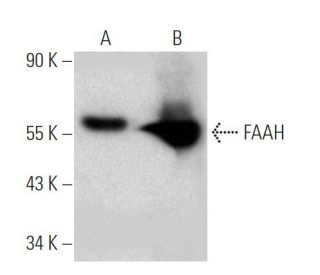
FAAH Antibody (27-Y): sc-100739
- FAAH Antibody (27-Y) is a mouse monoclonal IgG2a κ FAAH antibody, cited in 14 publications, provided at 100 µg/ml
- raised against a C-terminus region of FAAH of human origin
- recommended for detection of FAAH of mouse, rat and human origin by WB, IP and ELISA
- At present, we have not yet completed the identification of the preferred secondary detection reagent(s) for FAAH Antibody (27-Y). This work is in progress.

QUICK LINKS
SEE ALSO...
FAAH Antibody (27-Y) is a mouse monoclonal IgG2a kappa light chain antibody that detects FAAH protein of mouse, rat, and human origin by western blotting (WB), immunoprecipitation (IP), and enzyme-linked immunosorbent assay (ELISA). Anti-FAAH antibody (27-Y) is available as the non-conjugated isotype antibody. FAAH protein, or fatty acid amide hydrolase, is a crucial membrane-bound enzyme that plays a significant role in the hydrolysis of various primary and secondary fatty acid amides, including important neuromodulatory compounds such as anandamide and oleamide. The enzymatic degradation of anandamide to arachidonic acid and oleamide to oleic acid is vital for terminating the signaling functions of these bioactive lipids, thereby regulating physiological processes such as pain sensation, mood, and appetite. FAAH exhibits equivalent catalytic efficiency for both amides and esters, allowing FAAH to function effectively as both an amidase and an esterase. This dual functionality is essential for maintaining the balance of lipid signaling in the body. FAAH is involved in the uptake of anandamide by establishing and sustaining an inward concentration gradient, which is critical for its physiological effects. A natural single nucleotide polymorphism in the human FAAH gene, particularly in its homozygous form, has been linked to an increased risk of problem drug use, highlighting FAAH′s importance in addiction biology. The human FAAH gene is located on chromosome 1p33, making FAAH a significant target for research in pharmacogenomics and therapeutic interventions.
Alexa Fluor® is a trademark of Molecular Probes Inc., OR., USA
LI-COR® and Odyssey® are registered trademarks of LI-COR Biosciences
FAAH Antibody (27-Y) References:
- Fatty acid amide hydrolase competitively degrades bioactive amides and esters through a nonconventional catalytic mechanism. | Patricelli, MP. and Cravatt, BF. 1999. Biochemistry. 38: 14125-30. PMID: 10571985
- Role of fatty acid amide hydrolase in the transport of the endogenous cannabinoid anandamide. | Day, TA., et al. 2001. Mol Pharmacol. 59: 1369-75. PMID: 11353795
- A missense mutation in human fatty acid amide hydrolase associated with problem drug use. | Sipe, JC., et al. 2002. Proc Natl Acad Sci U S A. 99: 8394-9. PMID: 12060782
- CNR1 and FAAH variation and affective states induced by marijuana smoking. | Palmer, RHC., et al. 2019. Am J Drug Alcohol Abuse. 45: 514-526. PMID: 31184938
- FAAH levels and its genetic polymorphism association with susceptibility to methamphetamine dependence. | Zhang, W., et al. 2020. Ann Hum Genet. 84: 259-270. PMID: 31789429
- The influence of FAAH genetic variation on physiological, cognitive, and neural signatures of fear acquisition and extinction learning in women with PTSD. | Crombie, KM., et al. 2022. Neuroimage Clin. 33: 102922. PMID: 34952353
- Nitric oxide positively affects endometrial receptivity via FAAH and NAPE-PLD in vitro. | Melford, SE., et al. 2021. Reprod Fertil. 2: 107-116. PMID: 35128447
- A genetic variant of fatty acid amide hydrolase (FAAH) exacerbates hormone-mediated orexigenic feeding in mice. | Balsevich, G., et al. 2023. Elife. 12: PMID: 37039453
- Functional Variation in the FAAH Gene Is Directly Associated with Subjective Well-Being and Indirectly Associated with Problematic Alcohol Use. | Bornscheuer, L., et al. 2023. Genes (Basel). 14: PMID: 37761966
- FAAH inhibition ameliorates breast cancer in a murine model. | Tripathy, M., et al. 2023. Oncotarget. 14: 910-918. PMID: 37921652
- Molecular characterization of an enzyme that degrades neuromodulatory fatty-acid amides. | Cravatt, BF., et al. 1996. Nature. 384: 83-7. PMID: 8900284
- Molecular characterization of human and mouse fatty acid amide hydrolases. | Giang, DK. and Cravatt, BF. 1997. Proc Natl Acad Sci U S A. 94: 2238-42. PMID: 9122178
Ordering Information
| Product Name | Catalog # | UNIT | Price | Qty | FAVORITES | |
FAAH Antibody (27-Y) | sc-100739 | 100 µg/ml | $339.00 |