
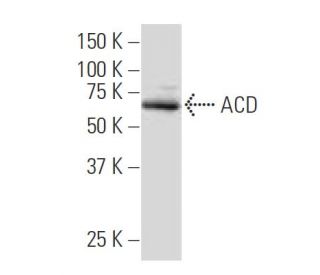
ACD Anticuerpo (AA-2): sc-100597
- ACD Anticuerpo (AA-2) es un monoclonal de ratón IgG1 κ, ver las 2 publicaciones, proporcionado como 100 µg/ml
- producido contra una proteina recombinante ACD de origen human
- recomendado para detectar ACD de human origen, mediante WB, IP, IF, IHC(P) y ELISA
- Actualmente, aún no hemos completado la identificación de los reactivos de detección secundaria preferidos para ACD Anticuerpo (AA-2). Este trabajo está en progreso.

ENLACES RÁPIDOS
VER TAMBIÉN ....
ACD (homólogo de la displasia suprarrenocortical) también conocido como PIP1, PTOP, TPP1 o TINT1, es un homólogo humano de 544 aminoácidos de la proteína Acd del ratón y es uno de los seis componentes del complejo telosoma/shelterina; un complejo involucrado en dar forma y proteger los telómeros. ACD es esencial para el ensamblaje adecuado y la estabilización del complejo asociado a los telómeros y es capaz de interactuar directamente con POT1 (protección de los telómeros 1) y TRF1 (factor de unión a repeticiones teloméricas 1), dos miembros adicionales del complejo de múltiples proteínas. Localizado en el núcleo, ACD ayuda a controlar la longitud y elongación de los telómeros al mediar la actividad de la telomerasa y el acceso de la telomerasa al ADN. A través de su capacidad para controlar y mantener el crecimiento de los telómeros, se cree que ACD está involucrado en la organogénesis. Se expresan dos isoformas de ACD debido a eventos de empalme alternativo.
Información sobre pedidos
| Nombre del producto | Número de catálogo | UNIDAD | Precio | CANTIDAD | Favoritos | |
ACD Anticuerpo (AA-2) | sc-100597 | 100 µg/ml | $339.00 |