
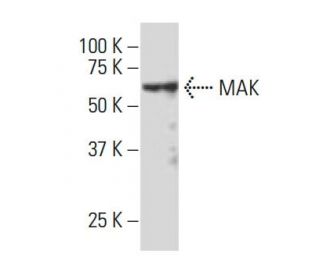


MAK Antibody (JK-10): sc-100432
- MAK Antibody (JK-10) is a mouse monoclonal IgG2a κ MAK antibody provided at 100 µg/ml
- raised against recombinant MAK of human origin
- recommended for detection of MAK of human origin by WB, IP, IF and ELISA
- At present, we have not yet completed the identification of the preferred secondary detection reagent(s) for MAK Antibody (JK-10). This work is in progress.

QUICK LINKS
SEE ALSO...
MAK Antibody (JK-10) is a mouse monoclonal IgG2a kappa light chain antibody that detects MAK protein of human origin by western blotting (WB), immunoprecipitation (IP), immunofluorescence (IF), and enzyme-linked immunosorbent assay (ELISA). Anti-MAK antibody (JK-10) is available as the non-conjugated isotype antibody. MAK protein, or male germ cell-associated kinase, is a crucial serine/threonine protein kinase that plays a significant role in spermatogenesis, primarily expressed in testicular germ cells. With a length of 623 amino acids, MAK contains a protein kinase domain that is essential for regulating the cell cycle and determining cell fate. MAK function is particularly important as MAK is homologous to the yeast protein Ime2, which is vital for initiating meiosis and spore formation. Additionally, MAK expression is induced by androgens, and MAK physically associates with the androgen receptor (AR), acting as a coactivator that enhances AR-mediated transcription. The interaction between MAK and AR is critical, as MAK knockdown leads to reduced levels of AR-responsive genes and inhibits androgen-induced cellular growth, highlighting MAK importance in male reproductive health and potential implications in androgen-related disorders.
Alexa Fluor® is a trademark of Molecular Probes Inc., OR., USA
LI-COR® and Odyssey® are registered trademarks of LI-COR Biosciences
MAK Antibody (JK-10) References:
- A testicular germ cell-associated serine-threonine kinase, MAK, is dispensable for sperm formation. | Shinkai, Y., et al. 2002. Mol Cell Biol. 22: 3276-80. PMID: 11971961
- CK2 controls multiple protein kinases by phosphorylating a kinase-targeting molecular chaperone, Cdc37. | Miyata, Y. and Nishida, E. 2004. Mol Cell Biol. 24: 4065-74. PMID: 15082798
- Activation of a nuclear Cdc2-related kinase within a mitogen-activated protein kinase-like TDY motif by autophosphorylation and cyclin-dependent protein kinase-activating kinase. | Fu, Z., et al. 2005. Mol Cell Biol. 25: 6047-64. PMID: 15988018
- Androgen receptor-dependent PSA expression in androgen-independent prostate cancer cells does not involve androgen receptor occupancy of the PSA locus. | Jia, L. and Coetzee, GA. 2005. Cancer Res. 65: 8003-8. PMID: 16140973
- Male germ cell-associated kinase, a male-specific kinase regulated by androgen, is a coactivator of androgen receptor in prostate cancer cells. | Ma, AH., et al. 2006. Cancer Res. 66: 8439-47. PMID: 16951154
- Identification of yin-yang regulators and a phosphorylation consensus for male germ cell-associated kinase (MAK)-related kinase. | Fu, Z., et al. 2006. Mol Cell Biol. 26: 8639-54. PMID: 16954377
- A novel mammalian protein kinase gene (mak) is highly expressed in testicular germ cells at and after meiosis. | Matsushime, H., et al. 1990. Mol Cell Biol. 10: 2261-8. PMID: 2183027
- Mouse Mak gene for male germ cell-associated kinase maps to chromosome 13. | Taketo, M., et al. 1994. Genomics. 19: 397-8. PMID: 8188277
Ordering Information
| Product Name | Catalog # | UNIT | Price | Qty | FAVORITES | |
MAK Antibody (JK-10) | sc-100432 | 100 µg/ml | $339.00 |