
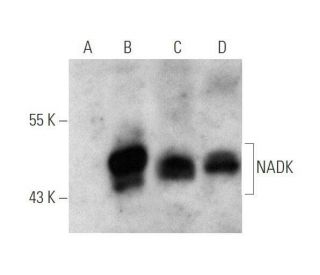
NADK Antibody (J-07): sc-100347
- NADK Antibody (J-07) is a mouse monoclonal IgG2a κ NADK antibody, cited in 6 publications, provided at 100 µg/ml
- raised against amino acids 1-447 representing full length NADK of human origin
- recommended for detection of NADK of mouse, rat and human origin by WB, IP and ELISA
- m-IgG Fc BP-HRP and m-IgG2a BP-HRP are the preferred secondary detection reagents for NADK Antibody (J-07) for WB applications. These reagents are now offered in bundles with NADK Antibody (J-07) (see ordering information below).

QUICK LINKS
SEE ALSO...
NADK Antibody (J-07) is a mouse monoclonal IgG2a kappa light chain antibody that detects NADK protein of mouse, rat, and human origin by western blotting (WB), immunoprecipitation (IP), and enzyme-linked immunosorbent assay (ELISA). Anti-NADK antibody (J-07) is available as a non-conjugated format. NADK, consisting of 446 amino acids, plays a crucial role in cellular metabolism by catalyzing the transfer of a phosphate group from ATP to NAD+, resulting in the formation of NADP+. This reaction is vital as NADP+ can be subsequently reduced to NADPH, a key electron donor in various biosynthetic pathways, including fatty acid and cholesterol synthesis. NADK regulation of NADPH levels is essential for maintaining cellular redox balance and supporting anabolic processes, making NADK a significant player in metabolic control. NADK is predominantly expressed in the placenta and moderately in other tissues such as the colon, kidney, brain, heart, liver, spleen, lung, testis, and stomach, highlighting its importance in both reproductive and metabolic functions. NADK utilizes divalent metal cations, such as zinc and manganese, as cofactors and exhibits optimal enzymatic activity at a pH of 7.5, further emphasizing NADK′s role in maintaining metabolic homeostasis.
Alexa Fluor® is a trademark of Molecular Probes Inc., OR., USA
LI-COR® and Odyssey® are registered trademarks of LI-COR Biosciences
NADK Antibody (J-07) References:
- Structural and functional characterization of human NAD kinase. | Lerner, F., et al. 2001. Biochem Biophys Res Commun. 288: 69-74. PMID: 11594753
- Cloning and characterization of two NAD kinases from Arabidopsis. identification of a calmodulin binding isoform. | Turner, WL., et al. 2004. Plant Physiol. 135: 1243-55. PMID: 15247403
- Evidence that feedback inhibition of NAD kinase controls responses to oxidative stress. | Grose, JH., et al. 2006. Proc Natl Acad Sci U S A. 103: 7601-6. PMID: 16682646
- Oxidative stress evokes a metabolic adaptation that favors increased NADPH synthesis and decreased NADH production in Pseudomonas fluorescens. | Singh, R., et al. 2007. J Bacteriol. 189: 6665-75. PMID: 17573472
- NAD kinase levels control the NADPH concentration in human cells. | Pollak, N., et al. 2007. J Biol Chem. 282: 33562-33571. PMID: 17855339
- NMN/NaMN adenylyltransferase (NMNAT) and NAD kinase (NADK) inhibitors: chemistry and potential therapeutic applications. | Petrelli, R., et al. 2011. Curr Med Chem. 18: 1973-92. PMID: 21517775
- NADK is activated by oncogenic signaling to sustain pancreatic ductal adenocarcinoma. | Schild, T., et al. 2021. Cell Rep. 35: 109238. PMID: 34133937
- Molecular properties and regulation of NAD+ kinase (NADK). | Oka, SI., et al. 2023. Redox Biol. 59: 102561. PMID: 36512915
- NADK-mediated de novo NADP(H) synthesis is a metabolic adaptation essential for breast cancer metastasis. | Ilter, D., et al. 2023. Redox Biol. 61: 102627. PMID: 36841051
- Knockdown of NADK promotes LUAD ferroptosis via NADPH/FSP1 axis. | Meng, X., et al. 2024. J Cancer Res Clin Oncol. 150: 228. PMID: 38700533
- NUAK1-Mediated Phosphorylation of NADK Mitigates ROS Accumulation to Promote Osimertinib Resistance in Non-Small Cell Lung Carcinoma. | Lin, W., et al. 2024. Cancer Res. 84: 4081-4098. PMID: 39159134
- Schisandra total lignans ameliorate neuronal ferroptosis in 3xTg-AD mice via regulating NADK/NADPH/GSH pathway. | Wu, Y., et al. 2025. Phytomedicine. 140: 156612. PMID: 40088743
Ordering Information
| Product Name | Catalog # | UNIT | Price | Qty | FAVORITES | |
NADK Antibody (J-07) | sc-100347 | 100 µg/ml | $339.00 | |||
NADK Antibody (J-07): m-IgG Fc BP-HRP Bundle | sc-539685 | 100 µg Ab; 10 µg BP | $361.00 | |||
NADK Antibody (J-07): m-IgG2a BP-HRP Bundle | sc-546751 | 100 µg Ab; 10 µg BP | $361.00 |