
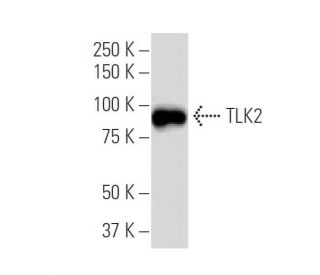


TLK2 Antibody (Y-17): sc-100346
- TLK2 Antibody (Y-17) is a mouse monoclonal IgG1 κ provided at 100 µg/ml
- raised against recombinant TLK2 of human origin
- recommended for detection of TLK2 of human origin by WB, IP, IF, IHC(P) and ELISA
- At present, we have not yet completed the identification of the preferred secondary detection reagent(s) for TLK2 Antibody (Y-17). This work is in progress.

QUICK LINKS
TLK2 Antibody (Y-17) is a mouse monoclonal IgG1 antibody that detects TLK2 in human samples through various applications including western blotting (WB), immunoprecipitation (IP), immunofluorescence (IF), immunohistochemistry with paraffin-embedded sections (IHCP), and enzyme-linked immunosorbent assay (ELISA). TLK2, a member of the Tousled-like kinase family, plays a crucial role in cell cycle regulation and exhibits maximum activity during S phase. TLK2 is essential for proper organ morphogenesis and shows predominant expression in testis, especially in pachytene spermatocytes and round spermatids, highlighting TLK2′s significance in spermatogenesis. TLK2′s structure includes a nuclear localization signal and a coiled-coil region in N-terminal domain, which facilitates dimerization and autophosphorylation, allowing TLK2 to phosphorylate exogenous substrates effectively. TLK2′s interactions with specific proteins during these processes underscore TLK2′s importance in multicellular organism development, making anti-TLK2 antibody (Y-17) a valuable tool for researchers studying cell cycle dynamics and reproductive biology.
Ordering Information
| Product Name | Catalog # | UNIT | Price | Qty | FAVORITES | |
TLK2 Antibody (Y-17) | sc-100346 | 100 µg/ml | $339.00 |