
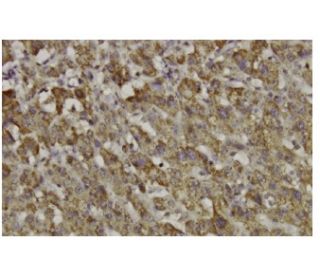

hepcidin Anticuerpo (56-Z): sc-100277
- hepcidin Anticuerpo 56-Z es un monoclonal de ratón IgG1 κ hepcidin Anticuerpo, ver las 5 publicaciones, proporcionado como 100 µg/ml
- planteada frente a la proteína recombinante de longitud completa con cartografía dentro de los aminoácidos 25-85 de hepcidin de origen human
- recomendado para detectar hepcidin de human origen, mediante IF, IHC(P) y ELISA
- Actualmente, aún no hemos completado la identificación de los reactivos de detección secundaria preferidos para hepcidin Anticuerpo (56-Z). Este trabajo está en progreso.

ENLACES RÁPIDOS
El anticuerpo hepcidina (56-Z) es un anticuerpo monoclonal de ratón IgG1 κ que detecta la proteína hepcidina de origen humano mediante IF, IHC(P) y ELISA. Este anticuerpo está disponible como anticuerpo anti-hepcidina no conjugado. La hepcidina, también conocida como HAMP, HEPC, LEAP1 o HFE2B, es una proteína secretada de 84 aminoácidos que regula eventos de señalización relacionados con el hierro. Altamente expresada en el hígado con una menor expresión en el corazón, cerebro, pulmón, próstata y tiroides, se cree que la hepcidina mantiene la homeostasis del hierro y, en conjunto con la proteína HFE (una proteína defectuosa en la hemocromatosis hereditaria), puede mediar tanto el almacenamiento de hierro en los macrófagos como la absorción intestinal de hierro. Además, la hepcidina tiene una fuerte actividad antimicrobiana contra bacterias grampositivas y gramnegativas, así como ciertas cepas de levaduras, lo que sugiere que la hepcidina puede desempeñar un papel crucial en la prevención de infecciones bacterianas. Los defectos en el gen que codifica la hepcidina son la causa de la hemocromatosis tipo 2B (también conocida como hemocromatosis juvenil), un trastorno autosómico recesivo de inicio temprano que resulta en una sobrecarga severa de hierro y se caracteriza por fibrosis hepática, hipogonadismo hipogonadotrófico y miocardiopatía.
Alexa Fluor® es una marca registrada de Molecular Probes Inc., OR., USA
REIVEW LI-COR® y Odyssey® son marcas registradas de LI-COR Biosciences.
hepcidin Anticuerpo (56-Z) Referencias:
- LEAP-1, un nuevo péptido humano altamente unido por disulfuro, presenta actividad antimicrobiana. | Krause, A., et al. 2000. FEBS Lett. 480: 147-50. PMID: 11034317
- Hepcidina, un péptido antimicrobiano urinario sintetizado en el hígado. | Park, CH., et al. 2001. J Biol Chem. 276: 7806-10. PMID: 11113131
- Síntesis química de beta-defensinas y LEAP-1/hepcidina. | Klüver, E., et al. 2002. J Pept Res. 59: 241-8. PMID: 12010514
- La mutación del péptido antimicrobiano hepcidina se asocia a la hemocromatosis juvenil grave. | Roetto, A., et al. 2003. Nat Genet. 33: 21-2. PMID: 12469120
- La herencia digénica de mutaciones en HAMP y HFE da lugar a diferentes tipos de hemocromatosis. | Merryweather-Clarke, AT., et al. 2003. Hum Mol Genet. 12: 2241-7. PMID: 12915468
- La IL-6 media la hipoferremia de la inflamación induciendo la síntesis de la hormona reguladora del hierro hepcidina. | Nemeth, E., et al. 2004. J Clin Invest. 113: 1271-6. PMID: 15124018
- Avances recientes en la comprensión de la hemocromatosis: un estado de transición. | Robson, KJ., et al. 2004. J Med Genet. 41: 721-30. PMID: 15466004
- La hepcidina regula el eflujo celular de hierro uniéndose a la ferroportina e induciendo su internalización. | Nemeth, E., et al. 2004. Science. 306: 2090-3. PMID: 15514116
- La eritropoyetina media la expresión de hepcidina en hepatocitos a través de la señalización EPOR y la regulación de C/EBPalpha. | Pinto, JP., et al. 2008. Blood. 111: 5727-33. PMID: 18326822
- La hepcidina inhibe la apoptosis de los hepatocitos a través de la vía PERK en la lesión hepática aguda y la fibrosis. | Li, C., et al. 2025. Hepatol Commun. 9: PMID: 39699302
- Las proteínas plasmáticas de fase aguda como predictores potenciales de inflamación e infección intraamniótica en la rotura prematura de membranas pretérmino. | Cho, HY., et al. 2024. Innate Immun. 17534259241306237. PMID: 39711480
- Serie de casos de pacientes con rasgo de β-talasemia y sobrecarga de hierro: de la supresión multifactorial de la hepcidina al tratamiento con miniflebotomías. | Busti, F., et al. 2025. Haematologica.. PMID: 39744829
Información sobre pedidos
| Nombre del producto | Número de catálogo | UNIDAD | Precio | CANTIDAD | Favoritos | |
hepcidin Anticuerpo (56-Z) | sc-100277 | 100 µg/ml | $339.00 |